If you are involved in the Aerospace, Semiconductor, R&D, Solar, or Microchip manufacturing industries – chances are you come across flammable liquids on a daily basis.
According to the National Fire Protection Association (NFPA), U.S. municipal fire departments respond to an estimated average of 160,910 fires per year that start due to the ignition of a flammable or combustible liquid; 105,520 (65%) of which started at non-residential properties.

Flammable liquids are very common, especially in our industry, and today we will be covering what are flammable liquids, how and why they can catch fire, the different classifications, and a few examples of highly used industrial flammable liquids.
Topics
[DOWNLOAD] PDF: FLAMMABLE LIQUID CATEGORIES CHART
Flammable Liquid Definition
Flammable liquids are defined by the Occupational Safety and Health Administration (OSHA) as any liquid having a closed-cup flash point at or below 200°F (93°C).
Note: The National Fire Protection Agency (NFPA) has a very different definition of a flammable liquid and even more different classification system. We break down OSHA and NFPF’s definitions in this post about flammable liquid classes and categories so there is no confusion.
What is a flash point you might ask?
The flash point of a liquid is the lowest temperature at which the liquid gives off enough vapor to be ignited at the surface of the liquid. Did you catch that? It’s actually the vapor the liquid gives off that burns, not the liquid itself, which is a common misconception.
First, let’s cover how a flash point is actually recorded.
In order to measure a flash point, scientists in a controlled environment have to introduce an ignition source to the substance, increase the substance’s temperature, and wait for the “flash”.
Once it flashes, aka: the vapor catches fire, the temperature of the substance is recorded.
There are numerous methods of measuring a flash point, but for the most part, the methods are separated into two main categories: open-cup flash points and closed-cup flash points.
Open-Cup Flash Point
In any kind of flash point test, the substance is placed into some kind of container, usually referred to as a vessel.
In the case of open-cup testing, the substance is placed in a vessel with the top open to the environment and elements.
The temperature of the substance is raised, and an ignition source is placed over the top of the vessel, waiting for ignition.
As you can imagine, this method has a lot of variables and is not quite as accurate as the closed-cup method.

Closed-Cup Flash Point
In contrast, during a closed-cup flash point test, the vessel is sealed, and the ignition source is actually inside the vessel to closer simulate real-life situations (think of flammable liquid in a drum or fuel tank).
Keep in mind that because closed-cup flash points are conducted in a controlled and sealed vessel, the flash point is likely to be at a lower temperature than during an open-cup test.
This very reason is why it is industry standard to use closed-cup flash points to ensure safer practice and handling.

Now that we have covered how we find out if a liquid is flammable, let’s discuss the different flammable liquid classifications and their different flash point ranges.
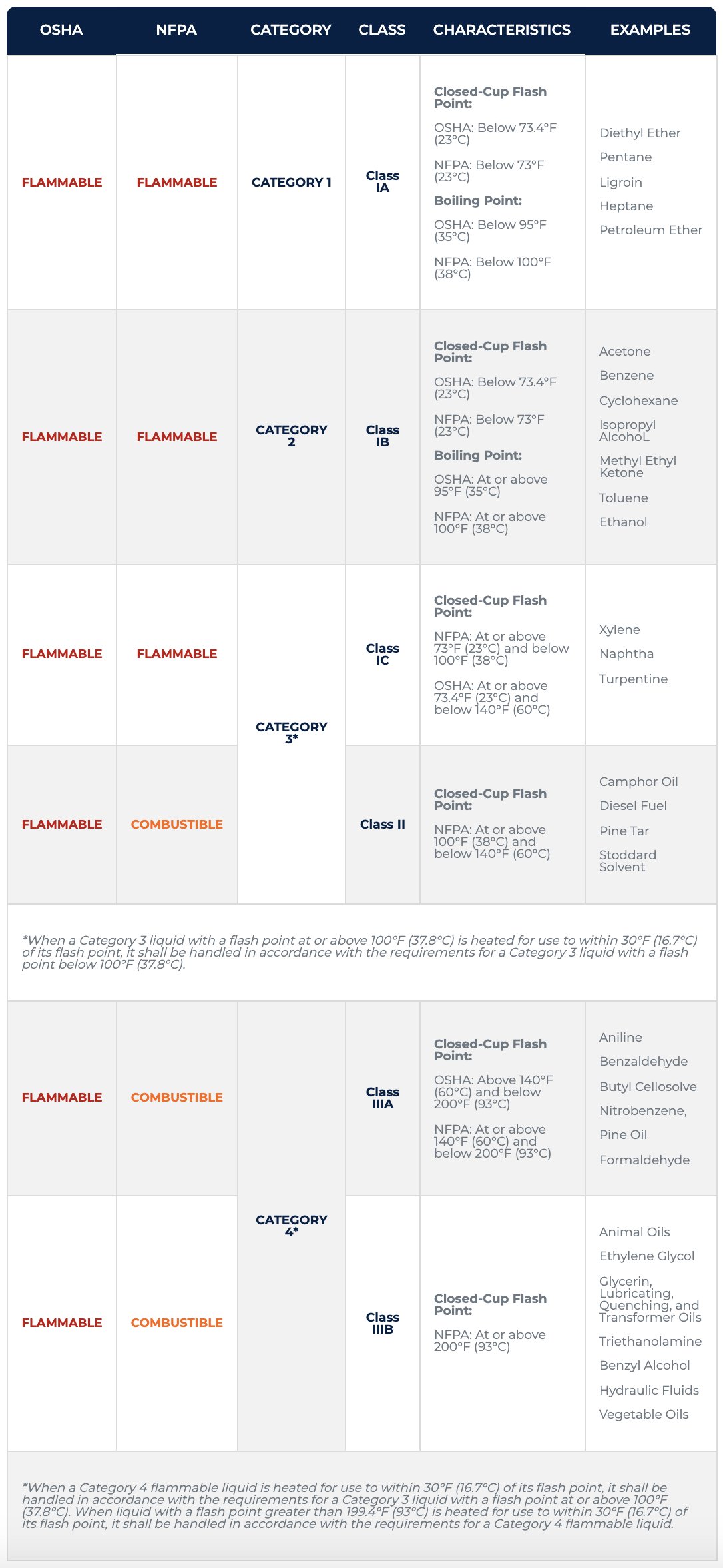
All flammable liquids fall into four distinct categories (courtesy of OSHA) based on their closed-cup flash point and their boiling point (the temperature at which the liquid starts to boil).
As you look through this chart you will also notice that there are also classes of flammable liquids.
The National Fire Protection Agency (NFPA) determines these flammable liquid classes.
As you have probably already realized – this is very confusing.
So not only did we create this great downloadable PDF of the chart below as a reference guide, but we also clear up any questions in this post >> Flammable Liquids Classes & Categories.